
Degenerative Disc Disease
Despite the name, degenerative disc disease is not a disease in the usual sense. It describes the gradual wear that spinal discs go through over time, and it is very common with age.
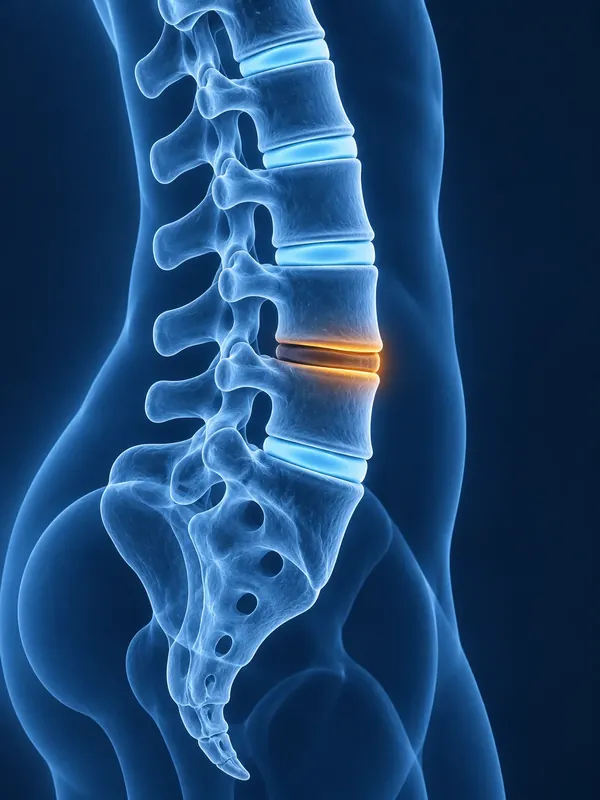
Degenerative disc disease.The disc loses height and cushioning over time, which can irritate the nearby joints and nerves. What is seen on imaging does not always match symptoms.
A lot of people hear this phrase from an X-ray or MRI report and worry. In many cases it is a normal part of aging, and it does not always cause pain.
About degenerative disc disease
Spinal discs act as cushions between the bones of the spine. With age they can lose some water content and height, which may change how the spine moves and loads.
Whether disc wear causes pain varies a lot from person to person. Pain often comes from irritation and inflammation in the area around the disc rather than from the wear alone.
Common symptoms
- Aching in the lower back or neck
- Stiffness, especially after sitting or in the morning
- Pain that changes with bending, lifting, or twisting
- Pain that spreads into the buttock or leg
- Occasional flare-ups
Common causes
- Normal aging
- Repetitive bending, twisting, or lifting
- Prior back injury
- Genetics
- Long periods of poor posture
How High-Pressure Cryotherapy (HPC) may help
High-Pressure Cryotherapy (HPC) uses high-pressure carbon dioxide (CO₂) to rapidly cool the skin over a specific treatment area. For degenerative disc disease, treatment goes on the areas where you feel pain, often the lower back or neck. HPC does not restore a worn disc and does not claim to. For many people it may help manage pain and inflammation and make movement more comfortable, though results vary. A typical series is 4 to 5 sessions, then we reassess. Many patients report relief after one or two visits, although individual responses may vary. If there is no meaningful improvement after the series, see a qualified healthcare provider. HPC does not restore a worn disc. It treats the sore area, and for many people it may help manage pain and inflammation.
Every treatment begins with a free consultation. Typical treatment takes about 3–6 minutes per area. HPC is not a substitute for medical care and does not replace a diagnosis.
A drug-free, needle-free option
No drugs. No needles. No incisions. No downtime. And we only treat if we think we can help.
Talk with your doctor about the risks and benefits of any treatment.
Frequently asked questions
Is degenerative disc disease always painful?
No. Many people have disc wear on imaging and no symptoms. Pain tends to come from irritation or inflammation around the disc.
Does HPC rebuild a worn disc?
No. HPC does not repair or regrow discs. It treats the sore area, and for many people it may help with pain and inflammation. Results vary.
How soon can I be seen?
Same-day appointments are often available at our Mineola and Rockville Centre locations. Book online or call and we will find the earliest time that works for you.
How many visits might I need?
For most people, we recommend an initial series of four to five sessions, then we check how you are doing. Many patients report relief after one or two visits, although individual responses may vary. Your plan depends on your situation, and we review how you are doing along the way. Results vary.
What does a visit cost?
The first treatment area is $90, with lower prices for additional areas, and discounted packages are available at our Rockville Centre location. See our pricing page for details.
This page is educational and is not medical advice. Individual results vary.
Related conditions

Lower Back Pain
Pain involving muscles, joints, discs, or ligaments of the lumbar spine.
Learn more →
Bulging & Herniated Disc
A spinal disc bulges or pushes out past its normal edge and can irritate nearby nerves.
Learn more →Spinal Stenosis
Narrowing in the spine that can crowd nearby nerves and cause back, leg, or arm symptoms.
Learn more →What patients say
Mineola
Rockville Centre
Reviews are provided by Google. Individual experiences and results vary.
Ready to learn whether HPC may be right for you?
We'll discuss your symptoms, answer your questions, and determine whether treatment may be appropriate for your individual needs.