HPC vs. an Ice Pack: A Side-by-Side Look at Two Kinds of Cold Therapy
Most people already know one kind of cold therapy: the ice pack in the freezer. High-Pressure Cryotherapy is cold therapy too, so it is fair to ask what is actually different. The short version is how the cold is delivered, for how long, and who is checking your skin while it happens.
Both are cold therapy
Cold has well-studied effects on the body that are not unique to any one method. When skin and the tissue beneath it are cooled, nearby blood vessels narrow, which is called vasoconstriction, and nerves carry signals more slowly, which can dull the sensation of pain for a time [1]. Those general effects are why people have reached for cold for so long. Our post on the history of cold therapy covers that story, from ancient medicine to modern clinics.
HPC is a powerful form of cold therapy. The differences between HPC and an ice pack are in how the cold is delivered, how long it is applied, who applies it and how it is checked. We do not claim one is better than the other.
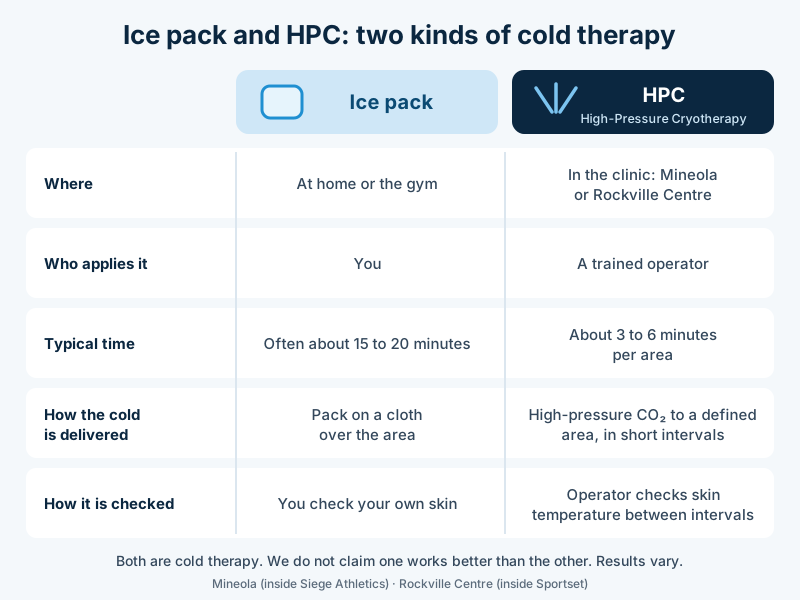
Side by side
The practical differences:
- Where: an ice pack is used at home or at the gym. HPC is done in a clinic.
- Who applies it: you apply an ice pack yourself. HPC is applied by a trained operator.
- How long: an ice pack session is often about 15 to 20 minutes. HPC takes about 3 to 6 minutes per area, depending on the body part.
- How the cold is delivered: an ice pack rests on a cloth over the area. HPC delivers intense cold from high-pressure CO₂ to a defined area of skin, in short intervals.
- How it is checked: with an ice pack, you check your own skin. With HPC, the operator checks the skin temperature between intervals.
- Cost: an ice pack costs very little. HPC is a paid clinic treatment, and the consultation is free.
When an ice pack makes sense
An ice pack is simple, cheap and always on hand. Many clinicians suggest it at home for minor soreness, a bump or a hard workout. If you have just rolled an ankle, our guide on what to do after an ankle sprain covers the first steps and when to get it checked.
Use a cloth or towel between the pack and your skin, keep sessions limited, check your skin as you go, and never fall asleep with an ice pack on.
When people ask about HPC
People often ask about HPC when pain keeps returning, when they would like a short, targeted treatment done for them, or when they want a drug-free, needle-free option alongside their regular care. For more on that, see whether HPC is drug-free and needle-free.
HPC may help manage pain and inflammation-related symptoms. It does not repair tissue, it is not a substitute for medical care, and it does not replace ice at home if your clinician has suggested ice. Many people use both. If you are weighing any treatment, our checklist on how to know if a pain treatment is right for you can help.
Our sports injuries page covers the strains, sprains and overuse problems we see most often, and who we can and cannot treat.
Who should not use cold therapy
Cold is not right for everyone, whether it is an ice pack or HPC. People with certain circulation problems, cold-related blood disorders, severe cold sensitivity, numb skin or poor skin sensation, or open wounds or infection in the area need medical guidance first. We use extra caution with diabetes, neuropathy, Raynaud's phenomenon and blood thinners. After surgery we need your surgeon's clearance and at least 10 days since the procedure, and we never treat over an incision.
Two clinics: Mineola and Rockville Centre
If you are curious how it compares with the ice pack you use at home, you can try HPC inside Siege Athletics in Mineola or inside Sportset in Rockville Centre. At both, every visit starts with a free consultation, where we ask where it hurts, what you have been told it is and what you have already tried, including ice. If you are a good candidate and comfortable going ahead, treatment can happen in the same visit. A first visit usually runs 10 to 20 minutes including the consultation, and same-day appointments are often available.
Sources
- [1] White GE, Wells GD. Cold-water immersion and other forms of cryotherapy: physiological changes potentially affecting recovery from high-intensity exercise. Extreme Physiology & Medicine. 2013;2:26. doi:10.1186/2046-7648-2-26
How High-Pressure Cryotherapy may fit
You do not have to give up your ice pack. If you would like to add a short, clinic-based form of cold therapy alongside it and your regular care, ask about HPC at our Mineola or Rockville Centre clinic. The consultation is free, and we only treat if we think we can help.
HPC is not a substitute for medical care and does not replace a diagnosis.
Frequently asked questions
Is HPC better than an ice pack?
We do not make that claim. Both are cold therapy, delivered differently. HPC is a short, clinic-based treatment with skin temperature checks, and an ice pack is a simple home option. Results vary with both.
How long does HPC take compared with icing?
HPC takes about 3 to 6 minutes per area, depending on the body part. An ice pack session at home is often about 15 to 20 minutes.
Can I still use ice at home if I get HPC?
Follow your clinician's advice on icing at home. HPC does not replace ice your doctor or physical therapist has suggested, and many people use both. Ask your operator at your consultation.
What does HPC feel like compared with ice?
Most people describe an intense cold that passes quickly. The operator checks your comfort and skin temperature throughout and stops if something does not feel right.
Where can I try HPC on Long Island?
At both New York Cryogen clinics: Mineola (inside Siege Athletics) and Rockville Centre (inside Sportset). You can choose either one. Every visit starts with a free consultation, and same-day appointments are often available.
What happens at a first visit?
Every visit starts with a free consultation, a conversation where you ask questions and we explain the process. If you are comfortable, treatment can happen in the same session. Treatment takes about 3 to 6 minutes per area, and a first visit usually runs 10 to 20 minutes including the consultation. Same-day appointments are often available.
This article is educational and is not medical advice. Individual results vary.
More from Pain Education
Sprains, Strains, and Overuse: Questions to Ask Before You Get Back in the Game
Acute and overuse sports injuries, when to get evaluated first, and how High-Pressure Cryotherapy may help athletes with pain and inflammation.
Read more →Ankle Sprain: What to Ask Before Getting Back to Activity
What an ankle sprain involves, when to be evaluated for a possible fracture, and how High-Pressure Cryotherapy may help with pain and inflammation.
Read more →Cold Therapy for Pain: A Short History, and How HPC Compares With an Ice Pack
People have used cold for pain and swelling for thousands of years. Here is a brief history, and how High-Pressure Cryotherapy relates to an everyday ice pack.
Read more →What patients say
Mineola
Rockville Centre
Reviews are provided by Google. Individual experiences and results vary.