Ice or Heat for Lower Back Pain? What the Research Says, and Where Cold Therapy Fits
Ice pack or heating pad? Ask five people when your lower back flares and you may get five answers. The research is more modest than either camp suggests.
Check for red flags first
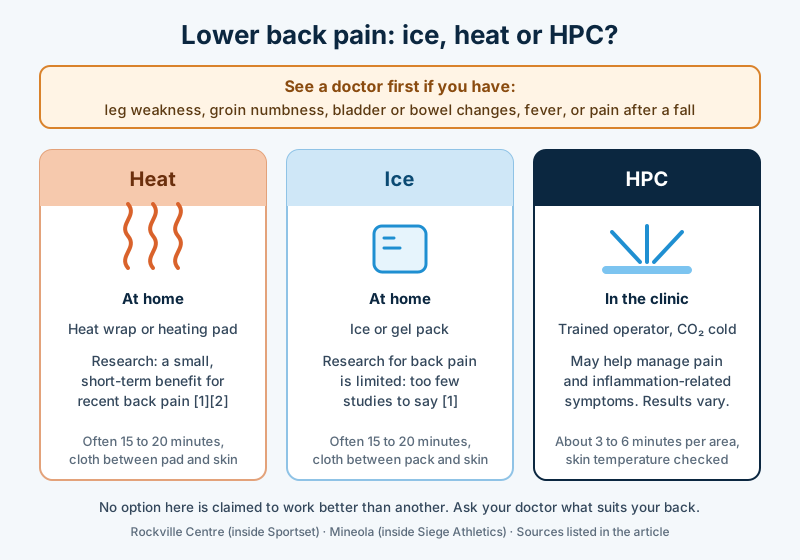
Most lower back pain is not dangerous, but some symptoms need a doctor before you try anything at home. Get medical care first if you have weakness in a leg, numbness in the groin or inner thighs, new trouble controlling your bladder or bowels, a fever, unexplained weight loss, or pain that started after a fall or accident.
If your back pain keeps returning, our guide to lower back pain that keeps coming back covers the common reasons and what to ask your doctor.
What the research says about heat
A Cochrane review, which pools the results of many trials, looked at heat and cold for low back pain. It found moderate evidence that a heat wrap gave a small, short-term improvement in pain and disability for people with recent (acute or subacute) low back pain [1]. Adding exercise to heat helped a little more in some trials [1].
The American College of Physicians guideline for low back pain lists superficial heat, such as a heating pad or heat wrap, among the first options to try for recent low back pain, alongside massage, acupuncture and spinal manipulation [2]. Many people find heat soothing when the back feels stiff, which is common first thing in the morning. Our post on morning back stiffness explains why.
What the research says about ice and cold
There is much less research on cold for lower back pain. The same Cochrane review found too little evidence to say how well cold works for low back pain, and conflicting results when heat and cold were compared directly [1]. The studies that exist are few and small, so the question is still open.
In general, cooling the skin and the tissue beneath it narrows nearby blood vessels, which is called vasoconstriction, and slows how fast nerves carry signals, which can dull the sensation of pain for a time [3]. Many people reach for cold when the back feels sore and irritated rather than stiff.
Using ice or heat safely at home
Whichever you choose, a few common-sense habits help:
- Put a cloth or towel between the pack and your skin
- Keep sessions limited, often around 15 to 20 minutes, and check your skin as you go
- Do not sleep on a heating pad or an ice pack
- Skip heat or cold on numb skin, broken skin or an area with poor circulation
- Keep moving gently as you are able, since long bed rest is not usually advised
Where High-Pressure Cryotherapy fits
HPC is a powerful form of cold therapy, done in a clinic by a trained operator. High-pressure CO₂ delivers intense cold to the skin over the sore area of the lower back in short intervals, with the skin temperature checked in between. Active treatment takes about 3 to 6 minutes per area. There are no drugs and no needles, which is why some people ask about it when looking for back pain options without medication.
HPC may help manage pain and inflammation-related symptoms in the lower back. It does not change a disc, a joint or the spine itself, and it is not a replacement for medical care or for the exercise and movement your doctor or physical therapist recommends. We do not claim that HPC works better than ice or heat. For how HPC and an ice pack differ, see the history of cold therapy and how HPC compares with an ice pack.
Our lower back pain page covers the back problems we see most often and who we can and cannot treat.
Two clinics: Rockville Centre and Mineola
For the lower back, wear a top you can easily lift or tuck up, since the area needs to be uncovered. Both clinics treat backs the same way: inside Sportset in Rockville Centre and inside Siege Athletics in Mineola. At both, every visit starts with a free consultation, where we ask where it hurts, what you have been told it is and what you have already tried, including ice or heat. If you are a good candidate and comfortable going ahead, treatment can happen in the same visit. A first visit usually runs 10 to 20 minutes including the consultation, and same-day appointments are often available.
Keep following your doctor's guidance, and tell us about any medication you take. After back surgery we need your surgeon's clearance and at least 10 days since the procedure, and we never treat over an incision or wound.
Sources
- [1] French SD, Cameron M, Walker BF, Reggars JW, Esterman AJ. Superficial heat or cold for low back pain. Cochrane Database of Systematic Reviews. 2006;(1):CD004750. doi:10.1002/14651858.CD004750.pub2
- [2] Qaseem A, Wilt TJ, McLean RM, Forciea MA; Clinical Guidelines Committee of the American College of Physicians. Noninvasive treatments for acute, subacute, and chronic low back pain: a clinical practice guideline from the American College of Physicians. Annals of Internal Medicine. 2017;166(7):514-530. doi:10.7326/M16-2367
- [3] White GE, Wells GD. Cold-water immersion and other forms of cryotherapy: physiological changes potentially affecting recovery from high-intensity exercise. Extreme Physiology & Medicine. 2013;2:26. doi:10.1186/2046-7648-2-26
How High-Pressure Cryotherapy may fit
If you have been going back and forth between ice and heat at home, ask about HPC at our Rockville Centre or Mineola clinic. Tell us what you have tried. The consultation is free, we only treat if we think we can help, and if anything you describe needs a doctor first, we will say so.
HPC is not a substitute for medical care and does not replace a diagnosis.
Frequently asked questions
Is ice or heat better for lower back pain?
Research leans slightly toward heat for recent lower back pain: a heat wrap gave a small, short-term benefit in reviewed trials, and research on ice for back pain is limited. Many people use whichever feels better. Ask your doctor what suits your back.
How long should I ice or heat my lower back?
Home sessions are often around 15 to 20 minutes, with a cloth between the pack and your skin. Check your skin as you go, and never sleep on a heating pad or ice pack.
Is High-Pressure Cryotherapy the same as icing my back?
Both are cold therapy, delivered differently. HPC uses high-pressure CO₂ in the clinic for about 3 to 6 minutes per area, with skin temperature checks. We do not claim it works better than ice or heat. It may help manage pain and inflammation-related symptoms, and results vary.
When should I see a doctor for lower back pain?
See a doctor first for leg weakness, numbness in the groin or inner thighs, new bladder or bowel problems, fever, unexplained weight loss, or pain after a fall or accident.
Where can I get HPC for lower back pain on Long Island?
At both New York Cryogen clinics: Rockville Centre (inside Sportset) and Mineola (inside Siege Athletics). You can choose either one. Every visit starts with a free consultation, and same-day appointments are often available.
What happens at a first visit?
Every visit starts with a free consultation, a conversation where you ask questions and we explain the process. If you are comfortable, treatment can happen in the same session. Treatment takes about 3 to 6 minutes per area, and a first visit usually runs 10 to 20 minutes including the consultation. Same-day appointments are often available.
This article is educational and is not medical advice. Individual results vary.
More from Pain Education
Lower Back Pain That Keeps Coming Back: What to Know Before You Book
Why lower back pain can return, which symptoms need a doctor first, and what to expect from a High-Pressure Cryotherapy visit on Long Island.
Read more →Why Is My Back Stiff in the Morning? Common Causes and When to Ask a Doctor
Why the lower back can feel stiff first thing in the morning, what is normal, what is not, and how High-Pressure Cryotherapy may help.
Read more →What Should I Ask Before Getting a Pain Injection? 12 Questions Worth Raising
A practical list of questions to bring to your doctor before any injection for pain, and where a drug-free, needle-free option like HPC may fit into the conversation.
Read more →What patients say
Mineola
Rockville Centre
Reviews are provided by Google. Individual experiences and results vary.