Needle-Free Options for Knee Pain: Where High-Pressure Cryotherapy Fits
Not everyone with a sore knee wants a needle, and that is a fair place to start. Most of what doctors and physical therapists suggest for knee pain does not involve one at all.

Why people look for needle-free options
Injections are a common and established part of knee care, and they help many people. Some people still want to know what else is available, or would like to try other approaches first. Others are simply curious about the full range of choices before they decide.
All of these are reasonable questions to bring to your doctor. The right plan depends on what is causing the pain, and that is worth confirming first. If you are weighing a shot, our list of questions to ask before a pain injection can help you get more out of that conversation.
Needle-free options to ask your doctor about
Every knee is different, so these are not recommendations for you personally. They are the needle-free options that commonly come up in a conversation with a doctor or physical therapist:
- Exercise and physical therapy to build strength and support around the knee
- Activity changes, such as pacing stairs, squats or long walks while the knee settles
- Ice or heat at home, as your clinician suggests
- A brace, sleeve, insoles or changes to footwear
- Medication, only as your doctor recommends
- High-Pressure Cryotherapy, a form of cold therapy applied in a clinic
Find out what is behind the pain first
Knee pain can come from osteoarthritis, a meniscus or ligament injury, tendon irritation, bursitis or overuse. The cause changes which options make sense. If your knee is swollen, our guide to why a knee swells explains the common reasons and when to be seen.
If your knee locks, gives way, cannot take your weight after an injury, or is hot, red and swollen, see a doctor before trying anything else.
Where High-Pressure Cryotherapy fits
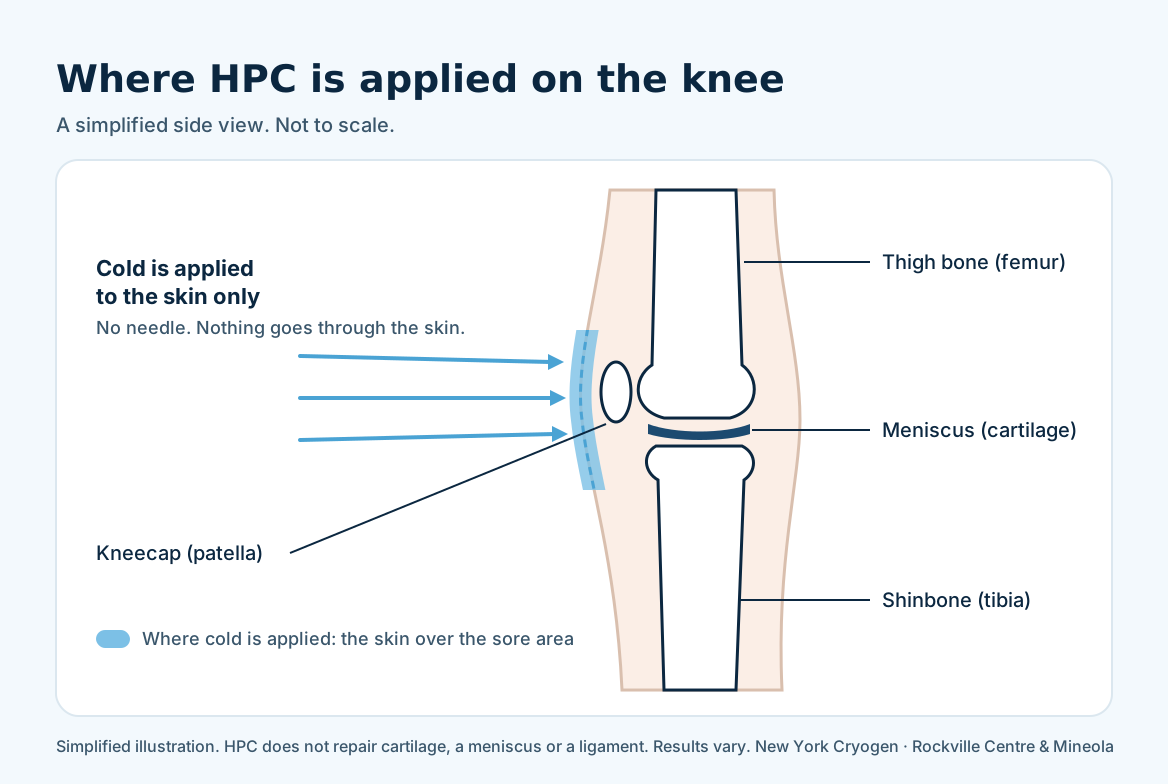
HPC uses intense cold from high-pressure CO₂ applied to the skin over the knee for about 3 to 6 minutes, depending on the area. There are no drugs, no needles and no incisions. Most people describe an intense cold that passes quickly. For a closer look at what happens during a treatment, see whether HPC is drug-free and needle-free.
HPC may help manage pain and inflammation-related symptoms around the knee. It does not repair cartilage, a meniscus or a ligament, and it is not a replacement for medical care. Many people use it alongside the care they already have, such as physical therapy.
Our knee pain page covers the knee problems we see most often and who we can and cannot treat.
How it compares with injections and surgery
We do not claim that HPC works better than an injection or surgery, and it is not a substitute for either when your doctor recommends them. They are different kinds of care. The plain difference is in how each is delivered: an injection uses a needle, surgery involves an incision, and HPC applies cold to the skin from the outside.
Decisions about injections and surgery stay between you and your doctor. If you have had an injection recently, tell us where and when at your consultation.
Two clinics: Rockville Centre and Mineola
For a knee, wear shorts or bring a pair to change into, since the area needs to be uncovered. You can be seen inside Sportset in Rockville Centre or inside Siege Athletics in Mineola, whichever is closer. At both, every visit starts with a free consultation, where we ask where it hurts, what you have been told it is and what you have already tried. If you are a good candidate and comfortable going ahead, treatment can happen in the same visit. A first visit usually runs 10 to 20 minutes including the consultation, and same-day appointments are often available.
Keep following your doctor's guidance, and tell us about any medication you take. After surgery we need your surgeon's clearance and at least 10 days since the procedure, and we never treat over an incision or wound.
If your clinician suggests ice or cold therapy
Ice is the best-known form of cold therapy, and many clinicians suggest it for sore, irritated areas. HPC is also a form of cold therapy, applied differently: high-pressure CO₂ rapidly cools the skin over the area, with an intense cold that passes quickly. A treatment takes about 3 to 6 minutes per area, where an ice pack session is often 15 to 20 minutes.
If your doctor has recommended ice or cold therapy for your problem, ask whether HPC may be a good fit. Results vary, and HPC is not a substitute for medical care.
How High-Pressure Cryotherapy may fit
If you want to try something for your knee that does not involve a needle, ask about HPC at our Rockville Centre or Mineola clinic. The consultation is free. We only treat if we think we can help, and if what you describe needs a specialist first, we will say so.
HPC is not a substitute for medical care and does not replace a diagnosis.
Frequently asked questions
Is there a needle-free option for knee pain?
Yes. Exercise and physical therapy, activity changes, ice or heat and bracing are all needle-free. High-Pressure Cryotherapy is also needle-free and drug-free: intense cold is applied to the skin over the knee, and nothing is injected.
Is HPC an alternative to a knee injection?
It is a different, needle-free option, not a replacement for care your doctor recommends. We do not claim it works better than an injection. Decisions about injections stay between you and your doctor.
Can HPC repair my knee?
No. HPC does not repair cartilage, a meniscus or a ligament. It may help manage pain and inflammation-related symptoms around the knee. Results vary.
How many sessions might my knee need?
Plans usually range from 2 to 5 sessions. The number of sessions varies from person to person, depending on the issue and level of pain.
Where can I get HPC for my knee on Long Island?
At both New York Cryogen clinics: Rockville Centre (inside Sportset) and Mineola (inside Siege Athletics). You can choose either one. Every visit starts with a free consultation, and same-day appointments are often available.
What happens at a first visit?
Every visit starts with a free consultation, a conversation where you ask questions and we explain the process. If you are comfortable, treatment can happen in the same session. Treatment takes about 3 to 6 minutes per area, and a first visit usually runs 10 to 20 minutes including the consultation. Same-day appointments are often available.
This article is educational and is not medical advice. Individual results vary.
More from Pain Education
Knee Pain on the Stairs: What Might Be Behind It?
Common causes of knee pain, what to tell your doctor, and how High-Pressure Cryotherapy may help with knee pain and inflammation.
Read more →Why Is My Knee Swollen? Common Causes and When to Be Seen
What knee swelling can mean, which signs need prompt medical attention, and how High-Pressure Cryotherapy may help with knee pain and inflammation.
Read more →Is HPC Drug-Free and Needle-Free? What Treatment Actually Involves
A plain-language look at what happens during High-Pressure Cryotherapy, what is and is not involved, and what to know about safety.
Read more →What patients say
Mineola
Rockville Centre
Reviews are provided by Google. Individual experiences and results vary.