
Sciatica
Sciatica describes pain that travels along the path of the sciatic nerve, often from the lower back through the buttock and down one leg.
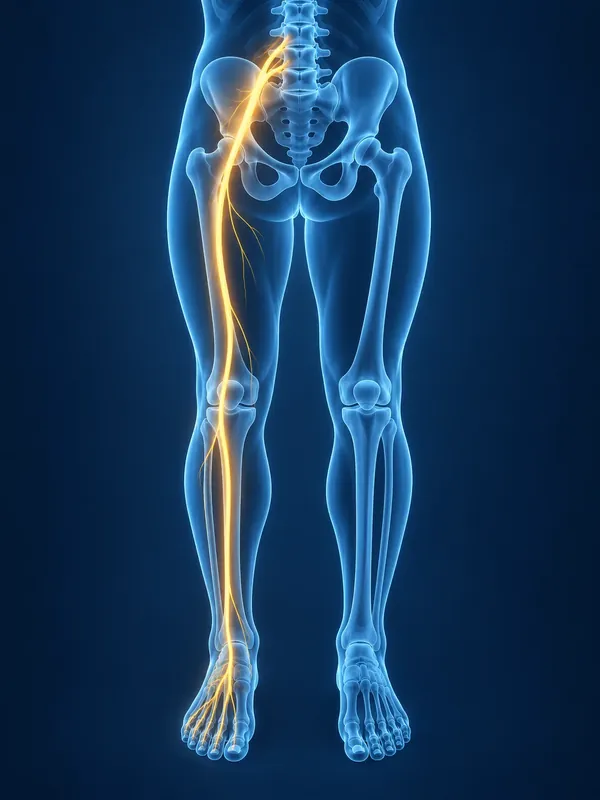 Irritated nerve root Sciatic nerve

That sharp, burning, or electric pain that runs from your back down your leg can make sitting, sleeping, and even walking feel like a negotiation.
About sciatica
Sciatica is a symptom rather than a diagnosis. It can come from irritation of a nerve root in the spine, or from tightness in nearby muscles such as the piriformis.
Symptoms can range from a mild ache to sharp, burning, or electric pain, and may be worse with sitting, coughing, or bending.
Common symptoms
- Pain from the lower back or buttock down the leg
- Burning, tingling, or "pins and needles"
- Leg or foot numbness or weakness
- Pain that worsens with sitting
Common causes
- Disc bulge or herniation irritating a nerve root
- Narrowing of the spinal canal (stenosis)
- Piriformis muscle tightness or irritation
- Injury or inflammation near the nerve
Sciatica is a symptom, not a diagnosis
The word describes where the pain goes, not why it is there. Common culprits are a disc pressing on a nerve root in the lower spine, a narrowing of the spinal canal, or a tight piriformis muscle in the buttock. Which one it is changes what helps, and your doctor is the person to work that out.
Sciatica and a herniated disc
A herniated disc is one common cause, but plenty of people have one with no symptoms, and you can have sciatica without one. An MRI report is one piece of the picture, not the whole thing.
Will it go away on its own?
Often it settles over a few weeks. If yours has dragged on, keeps coming back, or is getting worse, that is the point to get it properly evaluated.
What a visit looks like
You start with a conversation about where the pain runs and what you have tried. Sciatica pain can involve more than one area, such as the lower back and the buttock, so your visit may cover more than one. Pricing is per area, and discounted packages are available at our Rockville Centre location.
After the first round
At your consultation we explain the process and recommend a plan for your first sessions. For a long-standing problem, that is usually an initial round of 4 to 5 sessions.
After that we wait and see. For some people the pain stays away for days, for others weeks, months, or longer, and that depends a lot on the underlying condition. At the first sign it is coming back, we suggest coming in sooner rather than later. Many times a tune-up of 1 or 2 sessions is all it takes.
How High-Pressure Cryotherapy (HPC) may help
High-Pressure Cryotherapy (HPC) uses high-pressure carbon dioxide (CO₂) to rapidly cool the skin over a specific treatment area. For sciatica, treatment is aimed at the areas where you feel the pain, often the lower back and buttock. Many patients report significant relief after their initial round of 2 to 5 sessions, and HPC may help calm inflammation and make movement easier. How far that goes depends mostly on what is behind the sciatica, such as a disc or a tight piriformis, so results vary. No treatment makes the cause of sciatica disappear overnight. HPC is aimed at the painful areas, and for many people it may help keep inflammation and symptoms more manageable.
Every treatment begins with a free consultation. Typical treatment takes about 3–6 minutes per area. HPC is not a substitute for medical care and does not replace a diagnosis.
A drug-free, needle-free option
For sciatic pain, HPC is a non-invasive approach with no medication and no needles, applied to the skin over the painful areas.
No drugs. No needles. No incisions. No downtime. And we only treat if we think we can help.
Talk with your doctor about the risks and benefits of any treatment.
Watch a treatment
Real New York Cryogen treatment footage. Treatment area, comfort, and results vary by patient. A free consultation helps determine whether this is a fit.
See what a treatment looks like
Real New York Cryogen treatment footage. Treatment area, comfort, and results vary by patient. A free consultation helps determine whether this is a fit.
Frequently asked questions
What is piriformis-related sciatica?
The sciatic nerve runs close to the piriformis muscle in the buttock. When that muscle is tight or irritated it can contribute to sciatica-like pain. A clinician can help tell the difference.
Can sciatica go away on its own?
Often it eases over a few weeks. If it lasts longer, keeps returning, or is getting worse, get it evaluated.
Can a herniated disc cause sciatica?
Yes, a herniated disc can press on a nearby nerve root and cause sciatica symptoms. It is not the only cause, and not every herniated disc causes symptoms.
When should I get sciatica checked right away?
If you have leg weakness that is getting worse, numbness in the groin or inner thighs, or trouble controlling your bladder or bowels, seek care right away.
What happens if the pain comes back?
It can, and when depends on the underlying condition. We suggest coming in at the first sign instead of waiting for it to build. Many times a tune-up of 1 or 2 sessions is enough.
How soon can I be seen?
Same-day appointments are often available at our Mineola and Rockville Centre locations. Book online or call and we will find the earliest time that works for you.
How many visits might I need?
For most people, we recommend an initial series of four to five sessions, then we check how you are doing. Many patients report relief after one or two visits, although individual responses may vary. Your plan depends on your situation, and we review how you are doing along the way. Results vary.
What does a visit cost?
The first treatment area is $90, with lower prices for additional areas, and discounted packages are available at our Rockville Centre location. See our pricing page for details.
This page is educational and is not medical advice. Individual results vary.
Related conditions

Lower Back Pain
Pain involving muscles, joints, discs, or ligaments of the lumbar spine.
Learn more →
Hip Pain
Pain affecting the hip joint or surrounding muscles and tendons.
Learn more →
Knee Pain
Pain related to arthritis, injury, inflammation, or overuse.
Learn more →
Bulging & Herniated Disc
A spinal disc bulges or pushes out past its normal edge and can irritate nearby nerves.
Learn more →
Piriformis Syndrome
Deep buttock pain from a tight piriformis muscle that may irritate the sciatic nerve.
Learn more →Spondylolisthesis
A vertebra slips forward over the one below it, which can cause back pain and stiffness.
Learn more →What patients say
Mineola
Rockville Centre
Reviews are provided by Google. Individual experiences and results vary.
Ready to learn whether HPC may be right for you?
We'll discuss your symptoms, answer your questions, and determine whether treatment may be appropriate for your individual needs.